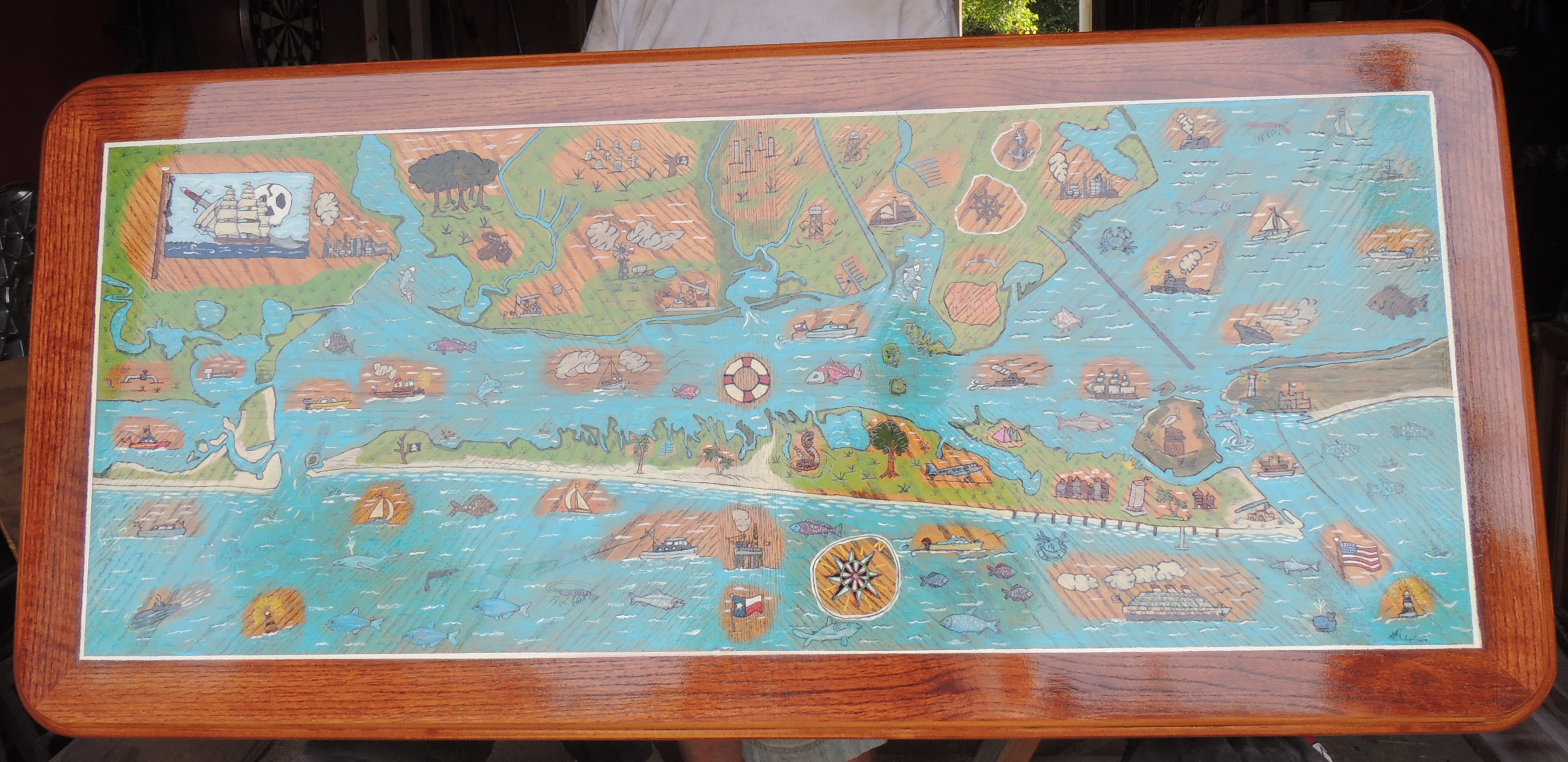
My mother's story starts in Mobile, Alabama. She was a Hallet. The Hallet's came over during the reign of Louis the 15th (1715-1774) as members of the colonial grant to Jean Baptiste Le Moyne, who founded the City of Mobile (1718).
With that said, let's start with my mother's mother, Sue Emily Nichols. Now Sue Emily is a bit of a Cinderella story.
She was born in Meridian, Mississippi October 4th, 1882, to Mary Blair Dunning,of Hertford, Perquimans, North Carolina, who was 37, and Willis Henry Nichols, member of the 37th Regiment (strawberry Boys) who got his liver shot up in the war, was already 45.
Sue, the youngest of eight (one died at birth), had a sister Lucy, three years older. Four brothers, Leo, Fred, Ed and Will and the eldest, a sister, Minnie, who was twelve years older than Sue.(side note; Seems Fred got himself killed on a one-way bridge about 1926. He blew his horn, the other fellow blew his horn, they meet in the middle of the bridge, killed them both, burned the cars up and destroyed the bridge. Paper said it was a hell of a fire. - Will was known for carrying a bucket of white-wash in his car. When he went anywhere, he would paint a white stripe on all the dead animals. On his way back, he of course picked up any dead animals didn't have a white stripe... (Make up your own joke.)
As the story goes, Sue learned to walk holding onto her father's cane as he led her around the bed, for he was laid up as his war wounds and age caught up with him... As Sue grew stronger, Willis grew weaker, passing away when Sue was about two. He (her father) had given her a rag-doll which quickly became Sue's prize possession.
This left Mary Blair with seven kids, ages fourteen and under. I don't know how she came along, I wasn't there.
Minnie married when she was about sixteen to a fellow from Biloxi, Mississippi.
When Sue was about eight or nine, her mother, Mary Blair passed away, maybe of yellow fever. The four boys stayed put, a couple of them had work. But they didn't know what to do with Sue...? So they shipped her down to Biloxi to stay with Minnie.
Now Minnie and her husband already had a 4 year old daughter, and Minnie's husband didn't like the idea of Sue being push off on them. He refused to put her in school (most likely cost money), took her rag-doll away and gave it to his daughter, who promptly tore it up. He put her to work washing dishes and scrubbing floors for extra income. She had no clothes to speak of and she wasn't allowed to make friends with the other kids around.
To give you some idea of Biloxi in those days, one of grandma's stories; She (remember, she's 8 or9) had been left there alone, to clean the house, while the family went to town. She was out in the yard hanging up clothes when she saw a man on a horse headed her way across the flat brush. She crawled up under the house to hide. As he got closer, she realized he didn't have any clothes on except for a loin cloth around his wait. He was an Indian. He rode right up to the house, rode around it a few times yelling Indian stuff. Sue kept quiet as a mouse under the house. He got off his horse, went into the house and rummaged through it. Went through all the draws, the wardrobes, the attic and took a gun, ammo, some silverware (real in those days) and some clothes. Then back on his horse, with his goodies in hand and rode away, back across the flat brush. She had seen a real Indian.
Sue was pretty smart, she had already learn to read and write and post a letter. She had done so with her mother.
So after about a year or so, Sue managed to get a letter off to her brothers in Meridian and told them of her plight.
Well the brothers talked about it, they were getting along okay, but what do you do with a little girl. Well.... It just so happens, the Civil War Veterans had created an orphanage just north of Meridian, in Laurderdale, Mississippi. So they figured they could go get Sue, put her in the orphanage in Laurderdale, where they could keep an eye on her, bring her clothes, visit and the like.
Well, they talked about it some more, and decided not to write Sue back. So the four of the them hopped a train for Biloxi and snatched Sue right off the rode on her way to clean a neighbor's house. Then right back on the next train to Meridian, and on to Laurderdale, where they put her in the orphanage.
Seems Sue was naturally happy, and got along well with the other children there at the home. She wrote Minnie, and told her where she was, and she was going to stay there. And that was that.
Back to the Hallet's. Hallet's were a prominent family in Mobile up until uncle Harry passed, he as the last of them. There was even a Hallet Mansion on Government Street. Not to mention a large plotted area in the Catholic cemetery adorned with Hallet.
Somewhere around 1820, John Henry Hallet went west and joined the Austin Colony over in Texas. He married a women named Margaret Lavaca, and was a veteran of San Jacinto. Around 1846, Margaret donated the land for the courthouse and founded Halletstville, in honor of her husband, in the middle of Lavaca County, Texas
Our story begins with George Henry Hallet (1842-1903) who was the coroner for a very large area around Mobile. While on a business trip to St. Louis, in 1874 (he was 32), he meet Katherine Lynch (also 32), who was about 15 when she was brought over during the Irish potato famine of 1858. He fell in love and Married her, right there in St. Louis, Missouri. At St. Johns. He died in 1903 of a heart attack, while running to catch a train in Greenville, Mississippi. Kate died a few months later of a broken heart.
They had four kids, Henry Harrington (grandpa), Laura, Mary Agnes (Aunt Daisy) and Georgie Julia.
When Harry (Henry Harrington) was about sixteen (around 1890) he got a job with the railroad, I believe it to be the L & M Railroad. At first as a brakeman, riding the rails all over the south. After a couple of years, he was a conductor on a regular run, which passed right through Laurderdale, Mississippi, this would have been around 1892.
Now the orphanage in Laurderdale had a unique relationship with the railroad. They had a well, which provided water for the engine, and they would feed the crew of the train, and in return, the railroad provided the orphanage food. It was also the city park, for the orphanage was on a large property next to the railroad.
Now one of the local churches was having a big social there at the city park, and all of the orphans were there, as was the train's crew on it's regular run... Now grandpa was 18 and Sue Emily, 10... Running around like a ten year old. Grandpa said, 'she was just the cutest thing ever. The prettiest little girl he'd ever seen. She was full of spring and joy.'
Well, they got to know each other, as the train passed through there a couple of times a week. Sue always meet the train on days when Harry was aboard, and they would have about thirty minutes together. Grandpa got her a doll, and some clothes. Her brothers told her to watch out, he's old, he could be up to no good.
This went on for some time, and in 1896, an apprenticeship machinist job opened up at the railroad, and grandpa wanted it, because it was better pay, and he would learn a trade, OJT.
So grandpa told Sue, he wouldn't be on the train anymore, but to pack her bags, and he would take her home to his mother. She flat refused, she wasn't leaving there unless she was a married woman, She just wasn't that kind of girl, (advise from her brothers). So he married her, right then and there, in Laurderdale Mississippi, on the 18th day of November 1886. And he took her home to his mother.
He told his mother, finish raisin' her up, I'm gonna sure enough marry her when she's 16. Well Kate finished her off, taught her to cook, how to kill and clean a chicken, how to can, how to keep a house, how to sew and run a budget... How to shop and strike a bargain. (Just a note, none of these people so far ever drove a car. Mobile had trolleys, as did New Orleans, as did Galveston.)
Grandpa bought a house there in Mobile, and when Sue Emily was sixteen, he took her into his home. When this happened, they were given a mantle clock, which we still have.
In the following years, they had a hard go of, although he was making plenty of money, She was having a hard time bearing children (perhaps because of her youth). The first one died, Henry Harrington, the second one died, George Henry, the third one died, Laura Clare. So they started over, the four one lived, Henry Harrington (Uncle Harry) in 1905, the fifth one lived, George Henry (Uncle George) in 1907, the sixth one died, Gertrude Helen 1910, the seventh one lived, Laura Clare 1912, the eighth one lived, Hazel Emily 1915, the ninth one lived, my mother Ruth Marie, 1919 and the tenth one lived, Mary Sue, 1922. (Side note; Both Harry & George were educated at Barton Academy, Government Street, Mobile.)
Not too long after Mary Sue was born, the railroad union went out on strike, and the railroad locked them out, and that was that... Grandpa had worked for them 32 years. We still have his official Hamilton railroad watch he bought in 1892 when he became a conductor, (it actually has a lock across the stem so it can't be set, only the railroad had a key, and only the railroad was suppose to set it. It would be checked, and if need be, set once a month.)
Let me mention here, Grandpa's sisters all married. Laura married and moved to California.
Agnes May (Great Aunt Daisy, lived to 101years)married Pat McDonough and moved to Whistler, Alabama, just up the road from Mobile. Mom said when they went to visit Aunt Daisy, Uncle Pat would go out and sprinkle the outhouse with lye. She said it was so thick, you could hardly breath.
Anyway; Georgie Julia married a Texan, Buddy Green, and moved to Galveston. He served on the Cone Johnson, a ferry serving highway 87 connecting Galveston with Bolivar. We knew him as the Rabbit man, because also he raised rabbits.
By this time, grandpa's eldest, My Uncle Harry was working for Brown Coal, they supplied the railroad with fuel. Which he later bought, added an ice plant and a warehouse and it became Brown Coal and Ice. Uncle Harry had three girls. As far as we know, he was the last Hallet in mobile.
Back at the ranch, seems Pat McDonough's (Daisy's husband) great uncle was 'McDonough Iron Works' of Galveston. A big deal in Galveston at the time. (The Landes-McDonough Mansion at 16th and Postoffice).
I think his name was Edward McDonough. When Pat found out that grandpa was out of work, he wrote his uncle in Galveston, and told him about grandpa and him being a trained machinist.
Well, come to Galveston, and we will put him to work, came the reply.
So in 1923 they packed up everything, grandpa, grandma, George, Laura, Hazel, my mother Ruth and Mary Sue and got on a train for Galveston. My mother, Ruth Marie was 4 years old.
They rented a house at 1714 33rd. Grandpa and Uncle George went to work right away at Todd Ship Yards. Grandpa as a machinist and George (who was 16) as an apprentice ship fitter. Todd had a launch which picked men up at the 23rd street pier in the morning, and carried them straight across the channel to Todd ship yards,(which was on Pelican Island) and of course returned them in the evening.
Grandma promptly enrolled Hazel (6) in Ursuline Academy there at 26th and N. Laura on the other hand, was already 10 years old, and didn't want to go to the academy, so grandma put her in the public school. (Later she went to Ball High.) Mother (Ruth) and Mary Sue were yet too young for school.
As the stories go; Grandpa and George were working at Todd, which put them on the docks most everyday. They would bring home a stalk of bananas off the banana boat, I think, which came into Galveston monthly.
Once Grandpa brought home a giant cotton ball, the damn grew into a 70 pound Irish sheep dawg. Mom said, nobody was going to bother them as long as CB(Cotton Ball) was around. Mom (Ruth) said, Her and Hazel and Mary Sue all slept in the same bed, and the dawg slept on the foot of the bed. If any of them moved, CB would growl.
Grandma said, about the time mom was 6, Hazel 8 and Mary Sue 3, she sent them out into the yard, with the hatchet, to kill the Christmas turkey. She watched through the window. Said it was the cutest thing ever.... Mom and hazel were chasing that turkey around the yard with Mary Sue in close pursuit. When they finally caught it, the battle was on, Hazel had it by the body, mom had it by head, and they dragged it over to the chopping block, with Mary Sue jumping up and down screaming with joy.... Nobody had the hatchet. Grandma said she was laughing so hard, she could hardly breath. Well she went out, gabbed the turkey, wrung it's neck and chopped off it head all in one motion, just like she always did, like mother Kate had taught her.
Mom was enrolled in Ursuline Academy in 1925. She graduated class of 1937.
Now in the early days, I mean the early days, back when the Spanish were snooping around these parts, Galveston was on the map as Snake Island, know to be inhabited by cannibals, the Karankawas. Well, Bernardo Del Galvez, the Viceroy of Bolivia was a bit of a crank. So to appease him, they named snake island for him, it was a large island (a sand bar) and it seemed fitting.
Well there was a reason it was called snake island, it was crawling with rattlesnakes... Now years later, it's was still crawling with rattlesnakes (I don't believe it is anymore, they have been run out), and grandpa and George would go out 'west' and build a campfire, and sit there and wait on the snakes to show up. Blame, Blame, Blame they shot a many a rattlesnake, there are early pictures of them holding up a pole with a dozen or more snakes hanging from it. (They Actually never said, but I think they ate them.)
With both grandpa and George working at Todd Ship Yards, wasn't long before they had built they own boat. They became avid fisherman of Galveston Bay.
Come April of 1928, Mary Sue went down with a toothache, which went bad with infection, and so Mary Sue, the youngest, passed away April 25, 1928.
It was very hard on grandma, she had lost four other children, but none she had reared for six years. She was heart broken. Arrangements were made by FP Malloy and Son at 2319 Avenue E.
The whole family put her on a train and took her back to Mobile, Alabama and laid her to rest in the Hallet plot, for she was a Hallet. It was a sad time for the Hallet's, for Mary Sue was filled with Joy, and now that joy was gone.
Around 1930, Grandpa bought house on the edge of town, out west, at 3320 Avenue O. Now this was only seven blocks from Ursuline Academy.
Mom and Hazel would walk to school down the alley behind their house, story was; there was a parrot that live on the balcony of one of the homes, he was a pirate parrot. He would walk up and down the railing calling out, 'trim the sails, ther' a blow coming.' Then he would hop onto the storm blinds, and run his beak up and down, making a clattering noise, calling out, 'let me in, let me in, it's hot as hell out here, it's hot as hell out here.' Mommy and Hazel thought that was scandalizes.
Now George bought a car, a 1930 Dodge, (he was the first Hallet to drive and own a car). It had electric start. He would take mom and Hazel to town to show off his car. Treat them to lunch at the counter, (they thought it stylish to sit at the counter)of the Star Drug Store. Then he would give them each a nickle, and over to the candy display they went. Now in those days, candy was in glass jars, and you bought it right out of the jar. There was a man to pick out what you wanted and bag it up. The prices were three for a penny, four for a penny, five for a penny, depending on what you wanted. If you shopped well, you could leave there with quite a bag of candy for a nickle.
Now grandma of course wrote Harry in mobile and told him George had bought a car. What a wondrous thing it was.
When the Circus came to town, George would take mom and Hazel down to meet the train,(I don't think the Santa Fe Station was there yet.) They would watch as all the animals were unloaded. There was always six or seven or more elephants, and they were not in cages, and they just walked off the train and hung out there with the people. Indeed the girls got to pet elephants. When the train was unloaded, there would be a big parade to the fairgrounds, the elephants leading the way.(I've never figured out where the station or fairground were). When they arrived at the fairgrounds, they would watch the elephants put up the tents. It was an all day ordeal.
The next day of course, they would all dress up in there finery, climb into George's automobile and go to the Circus.
Somewhere in here, Uncle Harry in Mobile, married Clair Louise Fletcher, and of course bought a car. Now there were two Hallet's that drove, and owned a car. Talk about up-town.
Mom and Hazel would walk down O to 25th and then down to the seawall. On the north east corner of Boulevard and 25th was the Derby. The Derby was a huge merry-go-round with a brass ring. It also had a winner. When the Derby stopped, there was always a winner, and you never knew who the winner was, until in stopped. If you were the winner, you got a free ticket, if you snagged the brass ring, you could trade it for ticket, or keep it as a prize.
Down a block or two around 23rd and boulevard was the Wild Mouse. It was an old wooden roller-coaster. From what I understand, it lived up to it's name. And of course there was Murddocks bath house and the beach.
Mom and Hazel watch them build the Sui-Jen (later known as the Balinese Room.) They played tennis at Mernard Park. All right there within walking distance of 3320 Ave O. This would include the Rosenberg Library, and St Patrick's.
Now Galveston was steady growing, and steady adding to the seawall... About 1933, Uncle George bought a seven room house, out west, (Notice how that keeps coming up, that's because out west, kept moving west) at 45th and R ½ for, brace yourselves, 3300 dollars. He paid cash for it, 3300 silver dollars. He lived there until his death in 1985. More about him as we go along.
Come along 1934 my mother is 15, my dad 16 pushing 17. Uncle George marries Alice Josephine Hegman, who was born Valentine's Day 1906.
I'm going to stop here, for the next story is; 'How to marry your childhood sweet-heart without knowing it.'
April 2023
Gary George Bernius


